
TL;DR
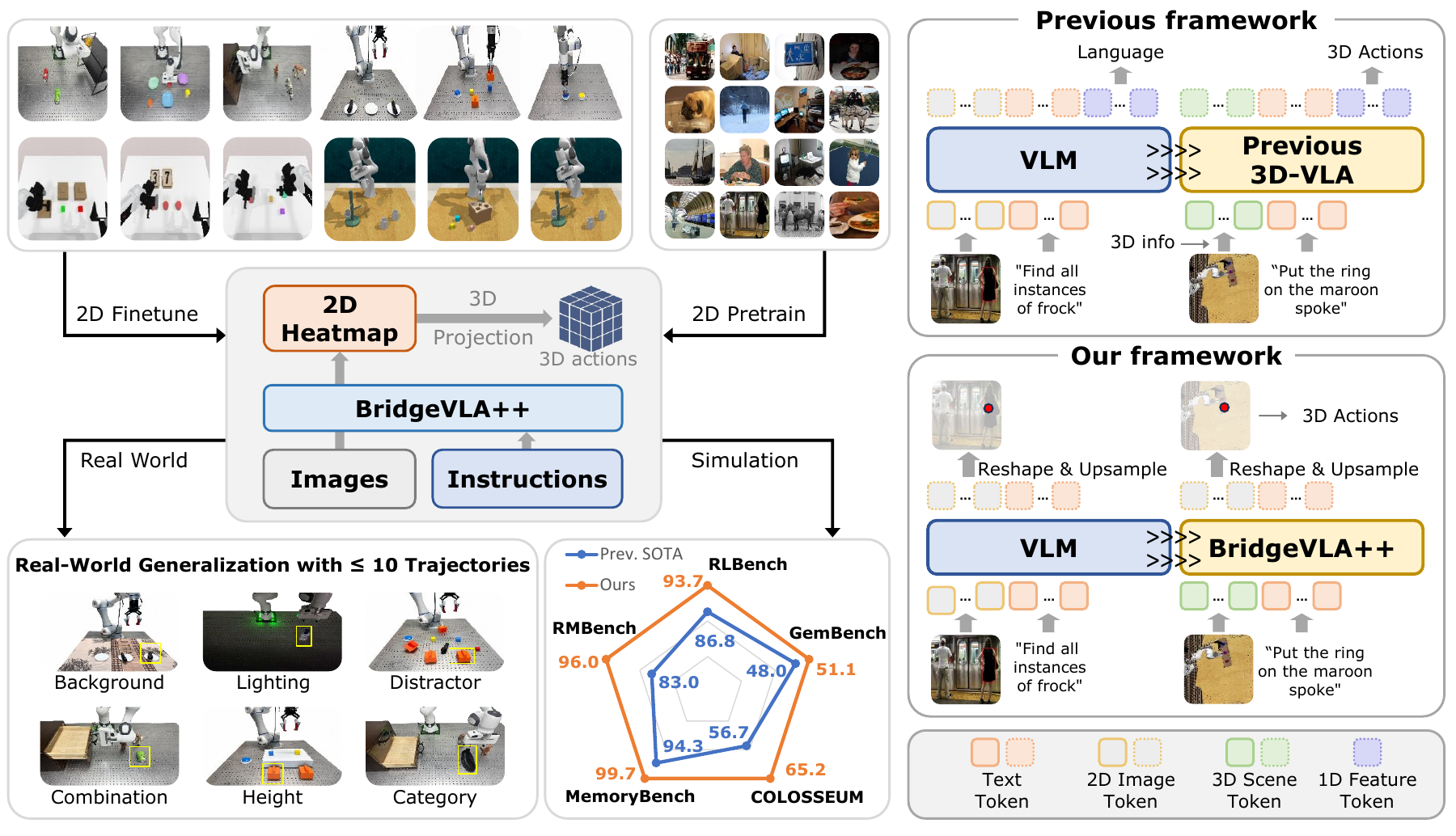
BridgeVLA++ achieves state of the art across five manipulation benchmarks with only 9.2% additional parameters, adding powerful spatio-temporal memory while fully improving or preserving BridgeVLA's exceptional data efficiency and OOD generalization.
Abstract
Leveraging pre-trained vision-language models (VLMs) to construct vision-language-action (VLA) models has emerged as a promising paradigm for 3D robot manipulation. However, existing 3D VLA methods remain data-hungry, generalize poorly to distribution shifts, and lack explicit memory of past observations. These limitations hinder their application to data-scarce, open-world and memory-dependent manipulation scenarios. In our previous work, BridgeVLA improves data efficiency and generalization by preserving the input–output alignment of a pre-trained VLM during 3D action learning: raw point clouds are projected into multi-view images, and intermediate heatmaps are predicted before generating robot actions.
In this work, we further extend BridgeVLA with a unified spatio-temporal memory architecture that models persistent spatial context and temporal interaction history. The resulting memory-augmented framework can reason over historical observations while preserving the hallmark data efficiency and strong generalization capability of BridgeVLA. Extensive experiments show that our framework establishes a strong foundation for spatial manipulation tasks and robust generalization (evaluating the base BridgeVLA on RLBench, COLOSSEUM and GemBench). When equipped with the unified spatio-temporal memory, BridgeVLA++ further achieves state-of-the-art performance on two challenging memory-dependent manipulation benchmarks without sacrificing the data efficiency and generalization of the original BridgeVLA. In addition, BridgeVLA++ extends effectively to bimanual manipulation and is validated on a new real-world robot embodiment, demonstrating its scalability across tasks, environments and robot embodiments. These results establish BridgeVLA++ as a unified 3D vision-language-action framework that simultaneously supports data-efficient learning, robust generalization and memory-aware robot manipulation.
One recipe, five suites. RMBench and MemoryBench are the memory-dependent ones BridgeVLA++ was built for; RLBench, COLOSSEUM and GemBench check that the base capabilities survive the memory extension. Pick a suite.
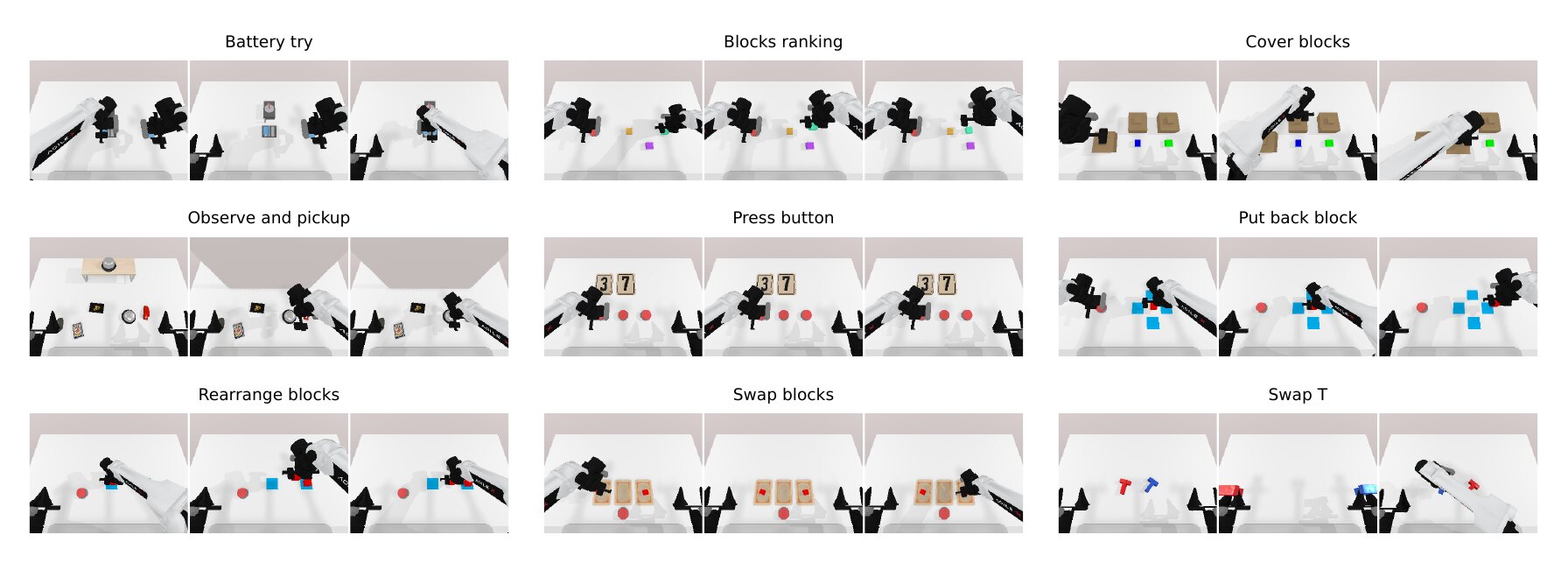
Nine dual-arm tasks that cannot be solved from the current frame alone — also the validation of the bimanual extension. BridgeVLA++ reaches a near-perfect 96.0%, while the memory-free base collapses to 18.9%.
| Method | Overall Avg. ↑ | M(1) tasks | M(n) tasks | |||||||||
|---|---|---|---|---|---|---|---|---|---|---|---|---|
| Observe & Pick Up | Rearrange Blocks | Put Back Block | Swap Blocks | Swap T | Avg. | Battery Try | Blocks Ranking Try | Cover Blocks | Press Button | Avg. | ||
| DP [Chi et al. 2024] | 5.8 | 1 | 0 | 0 | 11 | 20 | 6.4 | 10 | 10 | 0 | 0 | 5.0 |
| ACT [Zhao et al. 2023] | 5.9 | 1 | 29 | 0 | 2 | 2 | 6.8 | 19 | 0 | 0 | 0 | 4.8 |
| π0.5 [Physical Intelligence 2025] | 10.4 | 9 | 13 | 11 | 24 | 15 | 14.4 | 16 | 6 | 0 | 0 | 5.5 |
| X-VLA [Zheng et al. 2025] | 9.8 | 9 | 13 | 18 | 16 | 3 | 11.8 | 26 | 1 | 2 | 0 | 7.3 |
| Mem-0 [Chen et al. 2026] | 42.0 | 4 | 89 | 90 | 67 | 14 | 52.8 | 28 | 18 | 68 | 0 | 28.5 |
| Fast-WAM [Yuan et al. 2026] | 5.9 | 0 | 0 | 0 | 0 | 7 | 1.4 | 20 | 26 | 0 | 0 | 11.5 |
| LingBot-VA [Li et al. 2026] | 78.2 | 13 | 100 | 100 | 99 | 88 | 80.0 | 41 | 100 | 79 | 84 | 76.0 |
| MemoryWAM [Yang et al. 2026] | 83.0 | 27 | 100 | 100 | 100 | 94 | 84.2 | 41 | 100 | 98 | 87 | 81.5 |
| WLA-0 [Yang et al. 2026] | — | — | — | — | — | — | — | 45 | 23 | 84 | 74 | 56.5 |
| BridgeVLA (ours, base) | 18.9 | 75 | 0 | 1 | 11 | 8 | 19.0 | 72 | 0 | 3 | 0 | 18.8 |
| BridgeVLA++ (ours) | 96.0 | 81 | 100 | 100 | 99 | 96 | 95.2 | 96 | 100 | 99 | 93 | 97.0 |
Table 1. RMBench. Success rate (%) over 100 episodes per task on the nine dual-arm tasks, grouped by memory complexity. Baseline numbers are quoted from their sources; “—” denotes tasks a source does not evaluate. Best per task in bold.
Observe & Pick Up81%
Rearrange Blocks100%
Put Back Block100%
Swap Blocks99%
Swap T96%
Battery Try96% (best baseline 45%)
Blocks Ranking Try100%
Cover Blocks99%
Press Button93%
BridgeVLA reaches 90.5%, already above the previous state of the art; its remaining failures concentrate in occlusion-heavy tasks — exactly what the memory addresses, lifting BridgeVLA++ to 93.7%.
- Protocol. 100 demonstrations per task; mean over five evaluation runs of 25 episodes.
- 93.7%. +6.9 points over SAM2Act (86.8%), the previous state of the art.
- Where the memory helps. Occlusion-heavy precision tasks: Sort Shape +16.8, Place Cups +18.4.
| Method | Avg. SR (%) ↑ | Avg. Rank ↓ | Close Jar | Drag Stick | Insert Peg | Meat off Grill | Open Drawer | Place Cups | Place Wine | Push Buttons | Put in Cupboard | Put in Drawer | Put in Safe | Screw Bulb | Slide Block | Sort Shape | Stack Blocks | Stack Cups | Sweep to Dustpan | Turn Tap |
|---|---|---|---|---|---|---|---|---|---|---|---|---|---|---|---|---|---|---|---|---|
| PerAct [Shridhar et al. 2023] | 49.4 | 11.33 | 55.2 | 89.6 | 5.6 | 70.4 | 88.0 | 2.4 | 44.8 | 92.8 | 28.0 | 51.2 | 84.0 | 17.6 | 74.0 | 16.8 | 26.4 | 2.4 | 52.0 | 88.0 |
| Act3D [Gervet et al. 2023] | 65.0 | 9.17 | 92.0 | 92.0 | 27.0 | 94.0 | 93.0 | 3.0 | 80.0 | 99.0 | 51.0 | 90.0 | 95.0 | 47.0 | 93.0 | 8.0 | 12.0 | 9.0 | 92.0 | 94.0 |
| RVT [Goyal et al. 2023] | 62.9 | 9.08 | 52.0 | 99.2 | 11.2 | 88.0 | 71.2 | 4.0 | 91.0 | 100.0 | 49.6 | 88.0 | 91.2 | 48.0 | 81.6 | 36.0 | 28.8 | 26.4 | 72.0 | 93.6 |
| 3D Diffuser Actor [Ke et al. 2024] | 81.3 | 6.19 | 96.0 | 100.0 | 65.6 | 96.8 | 89.6 | 24.0 | 93.6 | 98.4 | 85.6 | 96.0 | 97.6 | 82.4 | 97.6 | 44.0 | 68.3 | 47.2 | 84.0 | 99.2 |
| RVT-2 [Goyal et al. 2024] | 81.4 | 5.97 | 100.0 | 99.0 | 40.0 | 99.0 | 74.0 | 38.0 | 95.0 | 100.0 | 66.0 | 96.0 | 96.0 | 88.0 | 92.0 | 35.0 | 80.0 | 69.0 | 100.0 | 99.0 |
| SAM2Act [Fang et al. 2025] | 86.8 | 5.47 | 99.0 | 99.0 | 84.0 | 98.0 | 83.0 | 47.0 | 93.0 | 100.0 | 75.0 | 99.0 | 98.0 | 89.0 | 86.0 | 64.0 | 76.0 | 78.0 | 99.0 | 96.0 |
| BridgeVLA (ours, base) | 90.5 | 4.75 | 100.0 | 97.6 | 91.2 | 100.0 | 99.2 | 58.4 | 89.6 | 100.0 | 91.2 | 96.0 | 95.2 | 93.6 | 95.2 | 55.2 | 84.8 | 88.8 | 100.0 | 92.8 |
| BridgeVLA++ (ours) | 93.7 | 3.64 | 100.0 | 98.4 | 99.2 | 100.0 | 99.2 | 76.8 | 95.2 | 100.0 | 92.0 | 99.2 | 92.8 | 95.2 | 96.0 | 72.0 | 85.6 | 98.4 | 97.6 | 89.6 |
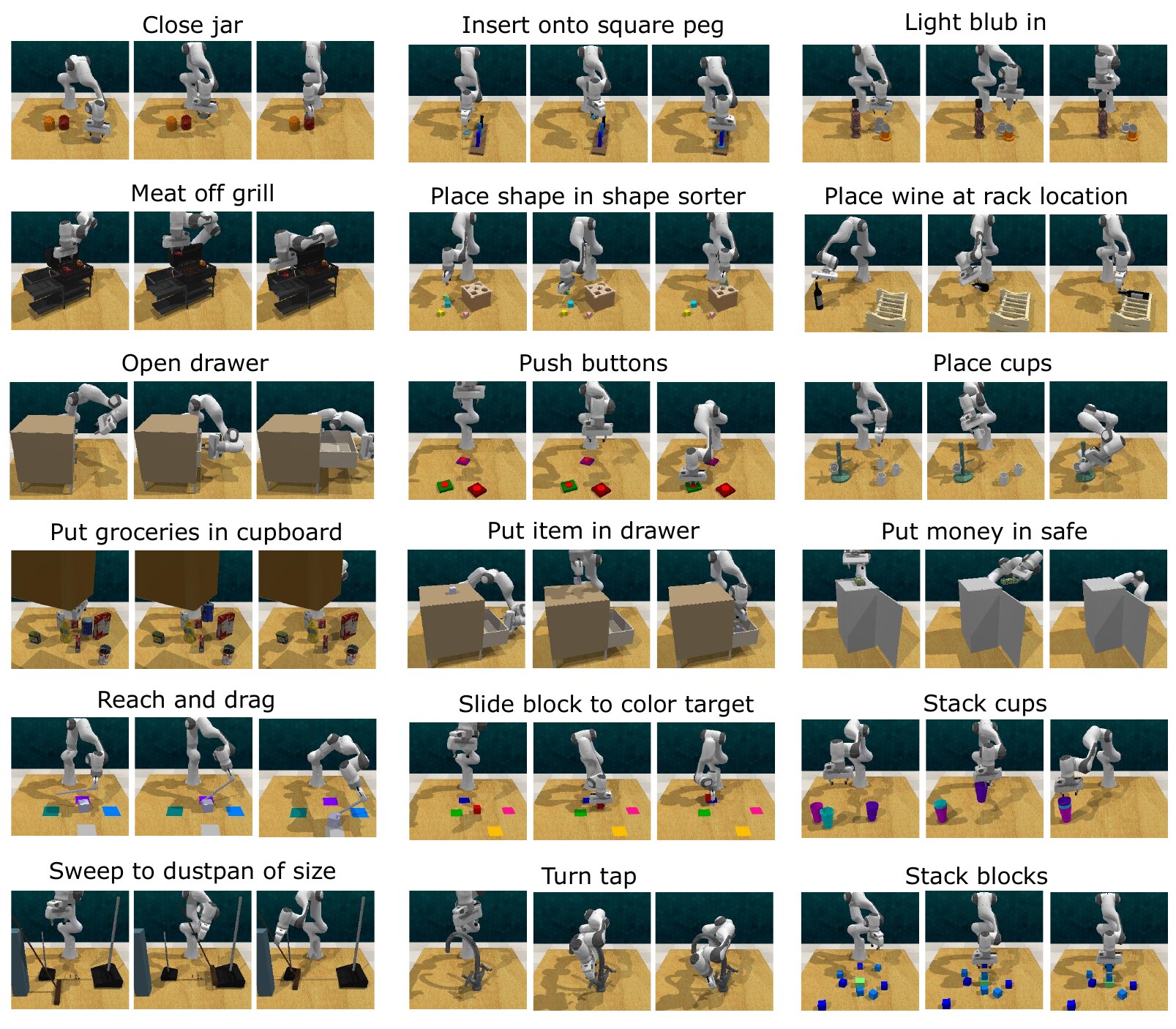
Table 2. RLBench. Success rate (%) on the 18 standard tasks with average success rate and average rank (lower is better). Our rows report the mean over five seeds of 25 episodes; per-seed standard deviations are given in the paper. Best average in bold.
One successful BridgeVLA++ rollout per task, straight from the evaluation logs.
Close Jar100.0%
Drag Stick98.4%
Insert Peg99.2%
Meat off Grill100.0%
Open Drawer99.2%
Place Cups76.8%
Place Wine95.2%
Push Buttons100.0%
Put in Cupboard92.0%
Put in Drawer99.2%
Put in Safe92.8%
Screw Bulb95.2%
Slide Block96.0%
Sort Shape72.0%
Stack Blocks85.6%
Stack Cups98.4%
Sweep to Dustpan97.6%
Turn Tap89.6%
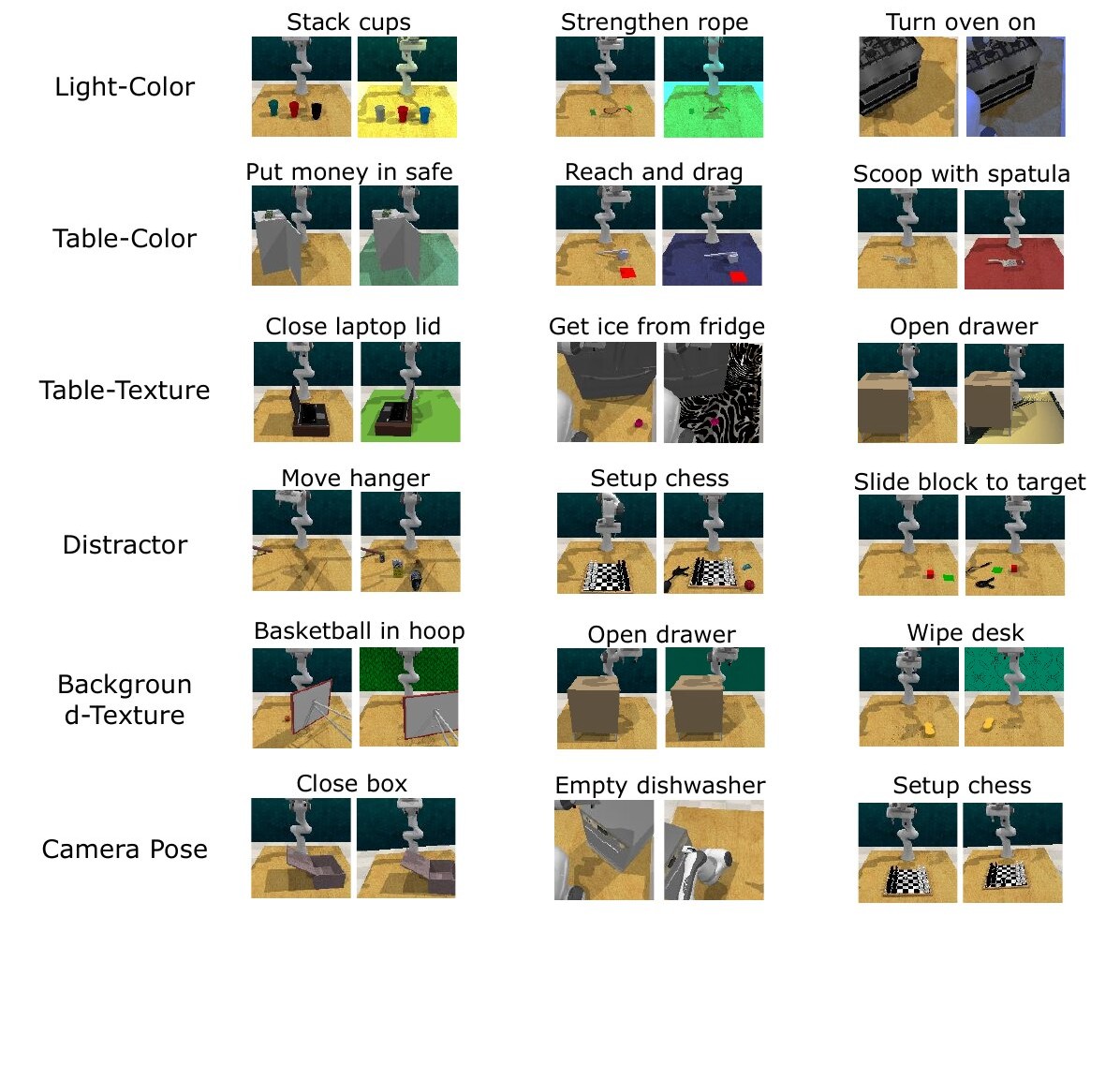
Trained on unperturbed RLBench data, then evaluated under 12 perturbation axes never seen in training. BridgeVLA reaches 64.0%, over 7 points above RVT-2, and the memory extension keeps that robustness (65.2%) — its largest gain in the hardest all perturbations setting (18.7% → 38.9%).
| Method | Avg. SR (%) ↑ | Avg. Rank ↓ | All Perturb. | MO Color | RO Color | MO Texture | RO Texture | MO Size | RO Size | Light Color | Table Color | Table Texture | Distractor | Background Texture | RLBench | Camera Pose |
|---|---|---|---|---|---|---|---|---|---|---|---|---|---|---|---|---|
| R3M-MLP [Nair et al. 2022] | 0.8 | 6.71 | 0.6 | 0.4 | 0.0 | 0.0 | 0.0 | 1.8 | 0.0 | 1.0 | 1.4 | 0.2 | 1.6 | 1.2 | 2.0 | 0.8 |
| MVP-MLP [Xiao et al. 2022] | 1.6 | 6.00 | 0.8 | 1.2 | 0.0 | 0.4 | 0.0 | 4.44 | 0.0 | 1.6 | 1.6 | 1.0 | 3.8 | 2.2 | 2.0 | 2.6 |
| PerAct [Shridhar et al. 2023] | 27.9 | 4.71 | 7.2 | 24.0 | 29.2 | 28.8 | 17.71 | 35.6 | 29.3 | 29.1 | 30.4 | 23.2 | 27.1 | 33.5 | 39.4 | 36.3 |
| RVT [Goyal et al. 2023] | 35.4 | 4.29 | 6.4 | 26.0 | 31.3 | 44.8 | 41.1 | 35.3 | 40.5 | 34.0 | 30.0 | 45.2 | 18.8 | 46.4 | 53.4 | 42.2 |
| RVT-2 [Goyal et al. 2024] | 56.7 | 2.86 | 15.6 | 53.0 | 54.6 | 59.7 | 56.7 | 60.9 | 53.4 | 58.0 | 62.6 | 56.6 | 60.8 | 68.7 | 68.8 | 64.4 |
| BridgeVLA (ours, base) | 64.0 | 1.50 | 18.7 | 60.5 | 63.8 | 63.5 | 68.4 | 69.3 | 61.7 | 69.7 | 75.7 | 71.3 | 51.8 | 74.8 | 73.1 | 73.8 |
| BridgeVLA++ (ours) | 65.2 | 1.64 | 38.9 | 68.7 | 62.7 | 65.7 | 65.5 | 71.5 | 62.0 | 68.2 | 71.5 | 69.2 | 61.6 | 69.5 | 68.5 | 68.7 |
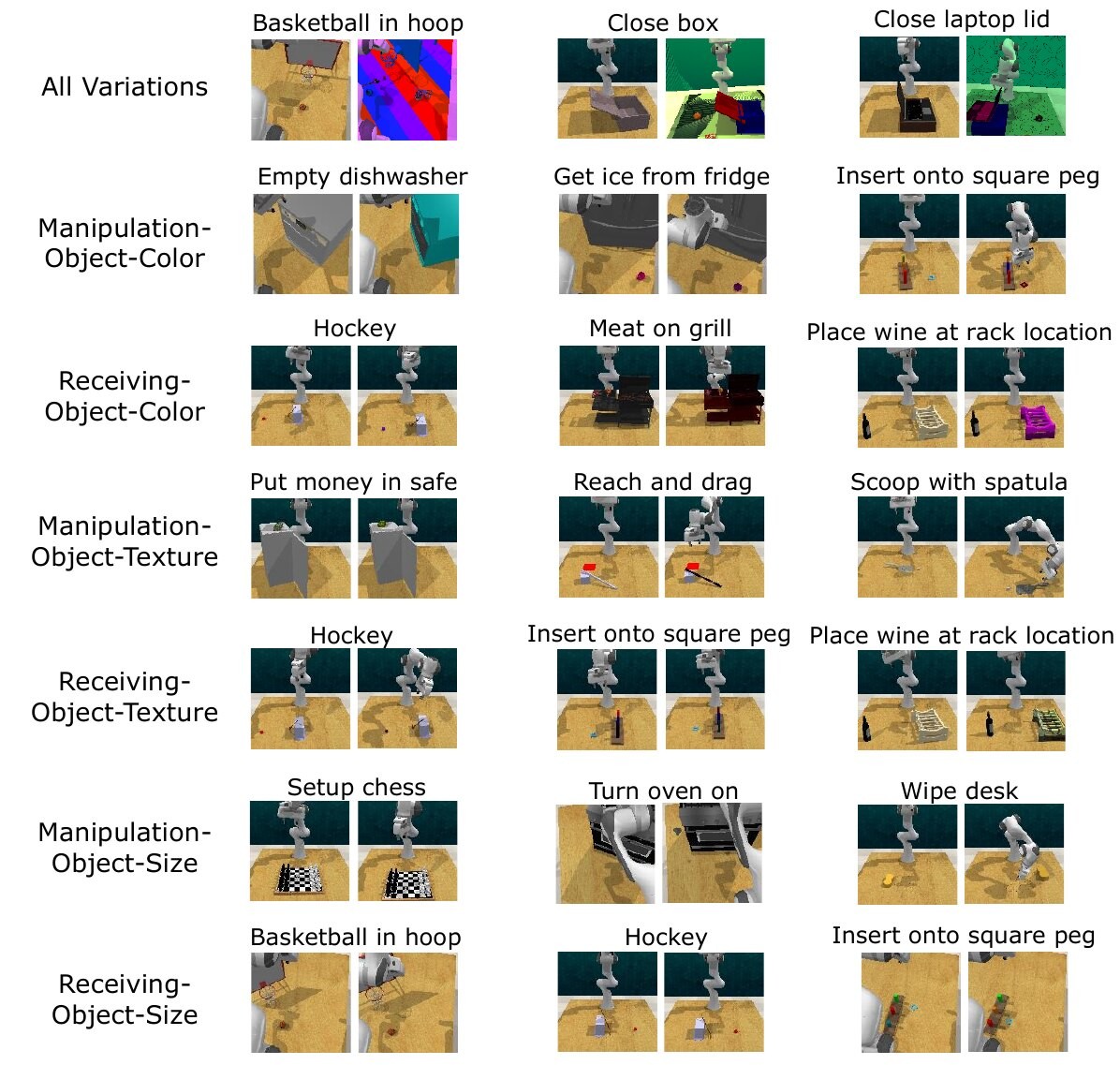
Table 3. COLOSSEUM. Success rate (%) across the 14 evaluation settings. MO and RO denote perturbations of the manipulated object and the receptacle object. Baseline numbers for R3M-MLP, MVP-MLP, PerAct and RVT are quoted from the benchmark; RVT-2 and our models were trained and evaluated by us (mean over three test repetitions; variances in the paper).
Nine representative COLOSSEUM task demonstrations.
Scoop with Spatula
Insert onto Square Peg
Close Laptop Lid
Move Hanger
Basketball in Hoop
Reach and Drag
Straighten Rope
Turn Oven On
Hockey
Trained on 16 tasks, evaluated on 44 held-out tasks across four generalization levels. BridgeVLA sets a state-of-the-art 50.0% average; BridgeVLA++ raises it to 51.1%.
- L1 Novel placements. 88.6%
- L2 Novel rigid objects. 68.9%, the best of all methods.
- L3 Novel articulated objects. 38.5% (base BridgeVLA: 43.8%, the best).
- L4 Long-horizon. 0.0% → 8.2%: the episodic memory finally gives the policy something to sequence over.
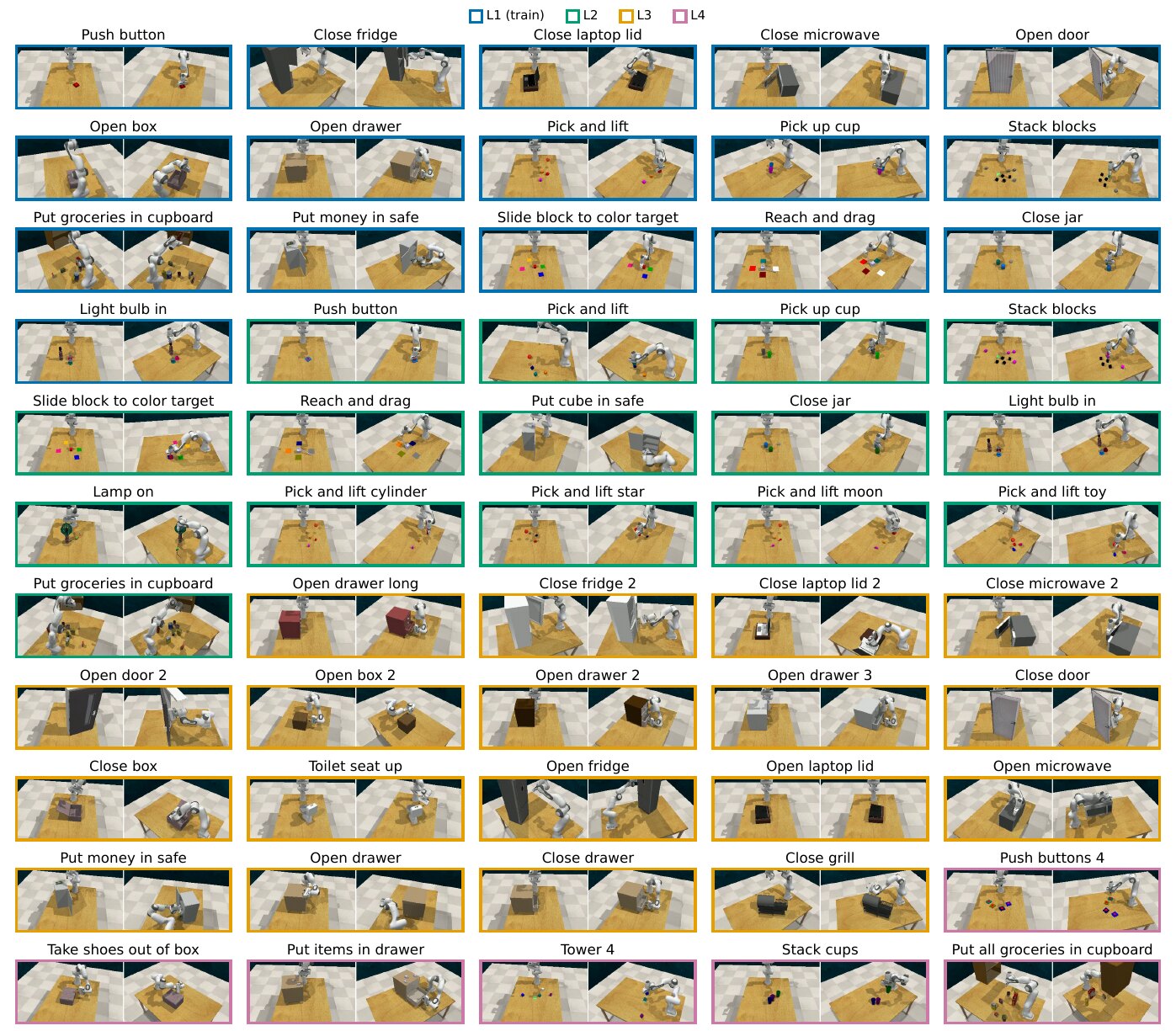
| Method | Avg. SR (%) ↑ | L1 Placement | L2 Rigid | L3 Articulated | L4 Long-Horizon |
|---|---|---|---|---|---|
| Hiveformer [Guhur et al. 2023] | 30.4 | 60.3 | 26.1 | 35.1 | 0.0 |
| PolarNet [Chen et al. 2023] | 38.4 | 77.7 | 37.1 | 38.5 | 0.1 |
| 3D Diffuser Actor [Ke et al. 2024] | 43.1 | 91.9 | 43.4 | 37.0 | 0.0 |
| RVT-2 [Goyal et al. 2024] | 44.0 | 89.1 | 51.0 | 36.0 | 0.0 |
| 3D-LOTUS [Garcia et al. 2024] | 45.7 | 94.3 | 49.9 | 38.1 | 0.3 |
| 3D-LOTUS++ [Garcia et al. 2024] | 48.0 | 68.7 | 64.5 | 41.5 | 17.4 |
| BridgeVLA (ours, base) | 50.0 | 91.1 | 65.0 | 43.8 | 0.0 |
| BridgeVLA++ (ours) | 51.1 | 88.6 | 68.9 | 38.5 | 8.2 |
Table 4. GemBench. Success rate (%) over 20 trials per task variation, five random seeds; per-level standard deviations are given in the paper. Baselines are quoted from the GemBench benchmark [Garcia et al. 2024], except the 3D Diffuser Actor average, recomputed as the mean of its four levels (its source prints 44.0). Our rows were trained and evaluated on keyframes only, without demo augmentation.
Nine representative GemBench task demonstrations.
Stack Blocks
Stack Cups
Put Money in Safe
Close Laptop Lid
Close Microwave
Close Grill
Push Button
Take Shoe Out of Box
Toilet Seat Up
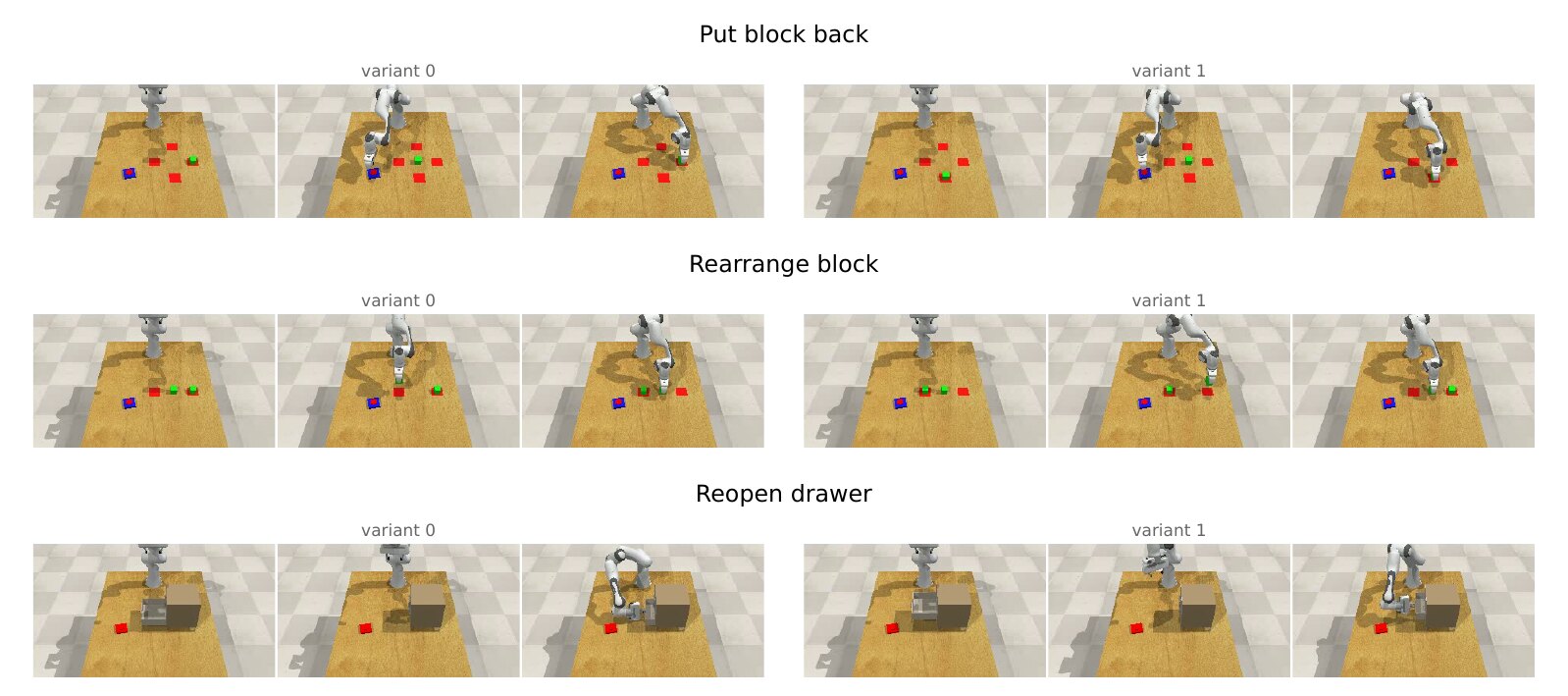
The memory generalizes beyond bimanual coordination: on the three single-arm MemoryBench scenarios BridgeVLA++ reaches 99.7 ± 0.3%, against 94.3% for SAM2Act+.
| Method | Avg. SR (%) ↑ | Reopen Drawer | Put Block Back | Rearrange Block |
|---|---|---|---|---|
| RVT-2 [Goyal et al. 2024] | 54.0 ±5.3 | 60.0 ±0.0 | 50.0 ±2.3 | 52.0 ±3.3 |
| SAM2Act [Fang et al. 2025] | 55.0 ±24.3 | 48.0 ±0.0 | 35.0 ±3.8 | 82.0 ±2.3 |
| SAM2Act+ [Fang et al. 2025] | 94.3 ±9.0 | 84.0 ±0.0 | 100.0 ±0.0 | 99.0 ±2.0 |
| BridgeVLA (ours, base) | 11.3 ±0.8 | 29.6 ±4.3 | 2.8 ±1.8 | 1.6 ±2.6 |
| BridgeVLA++ (ours) | 99.7 ±0.3 | 100.0 ±0.0 | 99.8 ±0.4 | 99.2 ±1.1 |
Table 5. MemoryBench. Single-arm memory-dependent suite. Baselines are quoted from [Fang et al. 2025] as mean±std over four evaluation runs; in the Avg. column the deviation is the spread across the three tasks. Our rows are mean±std over five evaluation seeds. The memory-free base policy collapses to 11.3%, confirming that these tasks genuinely require episodic memory.
Reopen Drawer100.0%
Put Block Back99.8%
Rearrange Block99.2%
Rollout videos
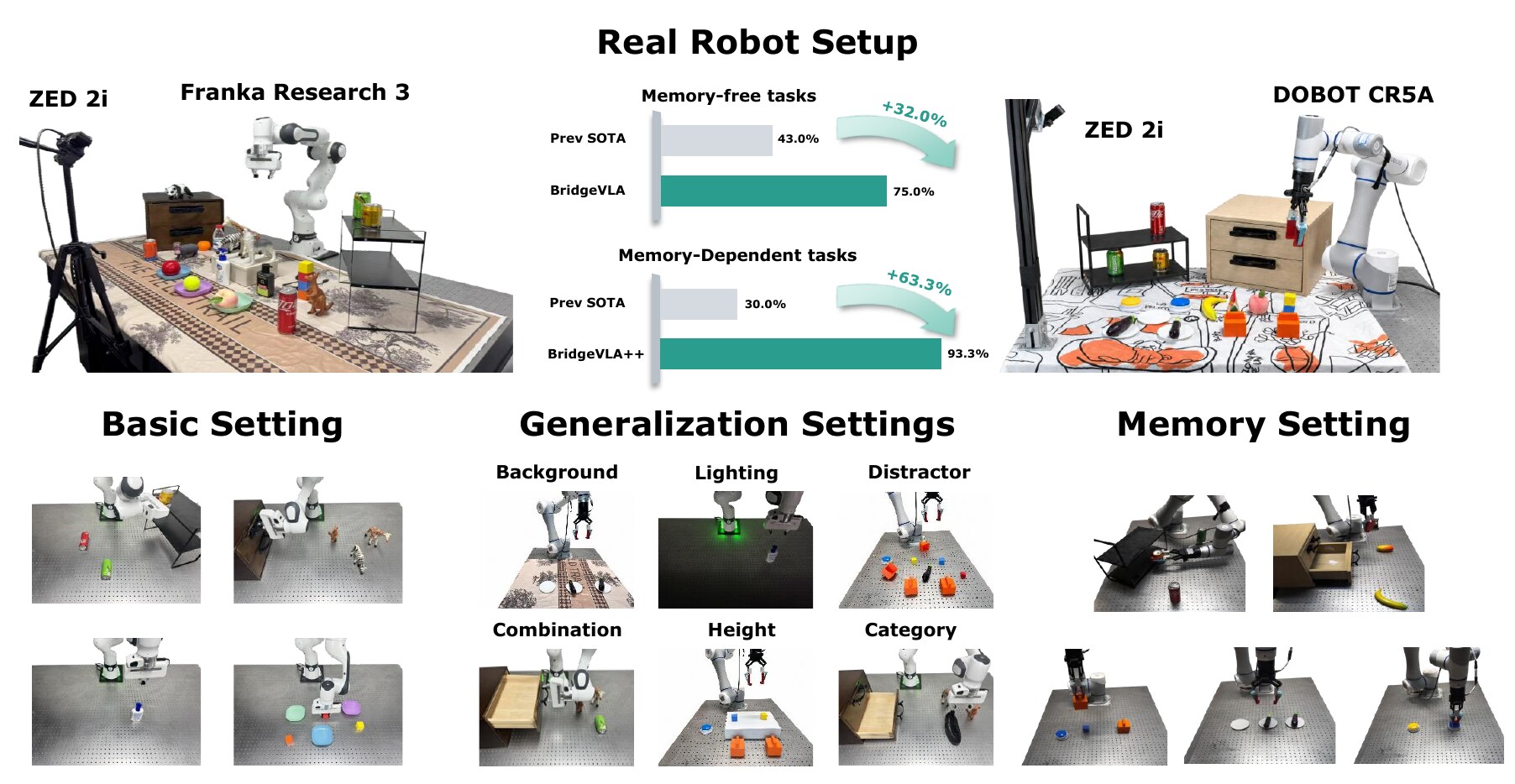
Every real-robot recording, up front. The browser below switches robot, task and setting on the spot; the written analysis further down the page has its own Dobot / Franka switch.
Browse every rollout
Every Dobot rollout: pick a task, then a setting, and see that exact clip with its success count.
Success over 10 trials — this task, this setting
BridgeVLA++ across all settings
Keyframe rollout (basic setting)
Browse the generalization rollouts
Six generalization settings, each recorded on three different tasks — switch with the Rollout buttons over the video. The raw clips are encoded at 6× real time; the Speed switch in the corner multiplies on top of that (default 1×).
Where it still fails
Category is the one setting whose absolute success rate stays low, and all three failures below come from it. They are not a collapse of the pre-trained grounding — the model still predicts accurate heatmaps on pre-training samples after fine-tuning. Two gaps are more likely: the pre-training images are third-person photographs rather than orthographic projections of a point cloud, and pre-training only ever asks for object localization, while manipulation needs keypoints that sit on no object at all.
“Place the bread in the green plate”
“Put the apple in the top shelf”
“Put the peach in the bottom shelf”
Memory on a held-out embodiment
Memory is tested on a second, held-out arm with three tasks where the current observation underdetermines the next action — plus two ordinary pick-and-place families that check the memory costs nothing when it isn't needed. All methods train on the same 70 demonstrations.
Press Button · counting
Press the blue button exactly N times (given in words, “twice” / “three times”), then the yellow button once. A press leaves no visible trace, so every post-press frame is identical up to nuisance variation: the running count exists only in the policy's history. Neither baseline solves a single trial in any setting.
Cover Blocks · occlusion
Cover all three blocks, then uncover only the block of the instructed color. Covering erases the color evidence from the scene, so the second phase is solvable only from the colour-to-location bindings formed before the covers went on.
Swap Eggplant · rearrangement
Two look-alike eggplants must end up each on the other's initial plate, using a third plate as a buffer that must be empty again at the end. Intermediate configurations recur across phases, so the correct next placement depends on which eggplant has already moved.
| Method | Mem. | Memory-dependent | Memory-free | |||
|---|---|---|---|---|---|---|
| Cover Blocks | Press Button | Swap Eggplant | Put in Drawer | Put on Shelf | ||
| SAM2Act+ [Fang et al. 2025] | ✓ | 20.0% | 0.0% | 70.0% | 60.0% | 20.0% |
| BridgeVLA (base) | ✗ | 0.0% | 0.0% | 60.0% | 100.0% | 90.0% |
| BridgeVLA++ | ✓ | 100.0% | 100.0% | 80.0% | 100.0% | 100.0% |
Table 6. Dobot, basic setting. Ten trials per language instruction. Put in Drawer and Put on Shelf are each evaluated with two instructions (upper and lower target) and reported as their average.
| Method | Mem. | Basic | Visual disturbance | ||||
|---|---|---|---|---|---|---|---|
| Distractor | Background | Height | Lighting | Avg. | |||
| Memory-dependent tasks | |||||||
| SAM2Act+ [Fang et al. 2025] | ✓ | 30.0% | 0.0% | 0.0% | 0.0% | 3.3% | 0.8% |
| BridgeVLA (base) | ✗ | 20.0% | 20.0% | 23.3% | 6.7% | 13.3% | 15.8% |
| BridgeVLA++ | ✓ | 93.3% | 73.3% | 86.7% | 76.7% | 76.7% | 78.3% |
| Memory-free tasks | |||||||
| SAM2Act+ [Fang et al. 2025] | ✓ | 40.0% | 0.0% | 0.0% | 0.0% | 7.5% | 1.9% |
| BridgeVLA (base) | ✗ | 95.0% | 57.5% | 72.5% | 67.5% | 67.5% | 66.3% |
| BridgeVLA++ | ✓ | 100.0% | 70.0% | 100.0% | 82.5% | 75.0% | 81.9% |
Table 7. Dobot, all settings. Each entry is the unweighted mean over the three memory-dependent or two memory-free tasks; Avg. averages the four disturbance settings. The memory advantage survives every disturbance, and on tasks that never needed memory BridgeVLA++ is no weaker than the base model in any setting.
General manipulation with 10 demonstrations
13 tasks, 10 demonstrations each. BridgeVLA completes 96.9% of trials and never falls below 9/10 on any task. The cleanest evidence for the alignment argument is π0: same PaliGemma backbone, different only in the action interface — and it reaches 3.8%.
| Method | Avg. SR (%) ↑ | Soda Can Bottom Shelf | Giraffe Lower Drawer | Red Block Blue Plate | Press Sanitizer | RedBull Top Shelf | RedBull Bottom Shelf | Coke Top Shelf | Orange Block Green Plate | Red Block Purple Plate | Yellow Block Green Plate | Zebra Upper Drawer | Zebra Lower Drawer | Wolf Upper Drawer |
|---|---|---|---|---|---|---|---|---|---|---|---|---|---|---|
| SpatialVLA (50 demos) [Qu et al. 2025] | 28.5 | 1/10 | 1/10 | 5/10 | 6/10 | 3/10 | 1/10 | 2/10 | 6/10 | 3/10 | 5/10 | 2/10 | 0/10 | 2/10 |
| SpatialVLA (10 demos) [Qu et al. 2025] | 3.1 | 0/10 | 0/10 | 0/10 | 2/10 | 0/10 | 0/10 | 0/10 | 1/10 | 1/10 | 0/10 | 0/10 | 0/10 | 0/10 |
| π0 [Black et al. 2024] | 3.8 | 0/10 | 0/10 | 2/10 | 1/10 | 0/10 | 1/10 | 0/10 | 0/10 | 0/10 | 1/10 | 0/10 | 0/10 | 0/10 |
| ACT [Zhao et al. 2023] | 22.3 | 2/10 | 2/10 | 3/10 | 2/10 | 3/10 | 1/10 | 2/10 | 2/10 | 3/10 | 4/10 | 1/10 | 2/10 | 1/10 |
| RVT-2 [Goyal et al. 2024] | 90.0 | 10/10 | 8/10 | 8/10 | 10/10 | 9/10 | 10/10 | 10/10 | 10/10 | 9/10 | 9/10 | 7/10 | 8/10 | 9/10 |
| BridgeVLA (ours, 10 demos) | 96.9 | 9/10 | 9/10 | 10/10 | 10/10 | 10/10 | 10/10 | 10/10 | 10/10 | 10/10 | 10/10 | 9/10 | 10/10 | 9/10 |
| BridgeVLA (ours, 3 demos) | 95.4 | 9/10 | 10/10 | 10/10 | 10/10 | 9/10 | 10/10 | 10/10 | 10/10 | 10/10 | 10/10 | 9/10 | 10/10 | 7/10 |
Table 8. Real Franka results, basic setting. Success counts over 10 trials per task. All methods use 10 demonstrations per task except SpatialVLA (50) and the 3-demonstration reference row. ACT is trained single-task, as it is not language-conditioned; test scenes are photographed and manually aligned across methods.
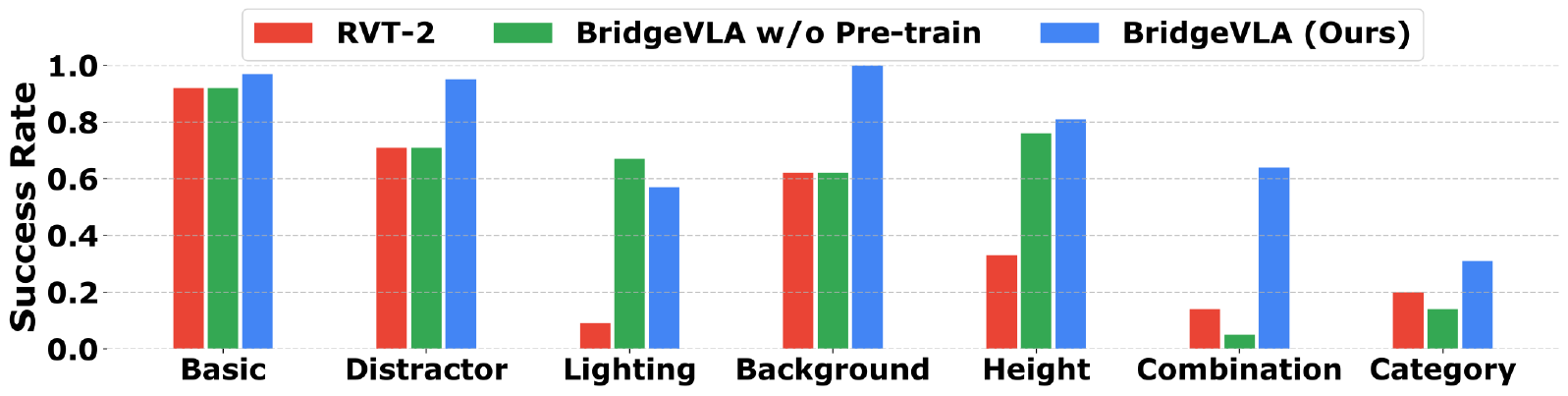
Generalization to unseen conditions and instructions
Six settings probe visual disturbance (Distractor, Lighting, Background, Height) and instruction-level generalization (Combination, Category). BridgeVLA beats RVT-2 in all seven settings, by 32% on average.
Part I · Base model
BridgeVLA — spatial input–output alignment
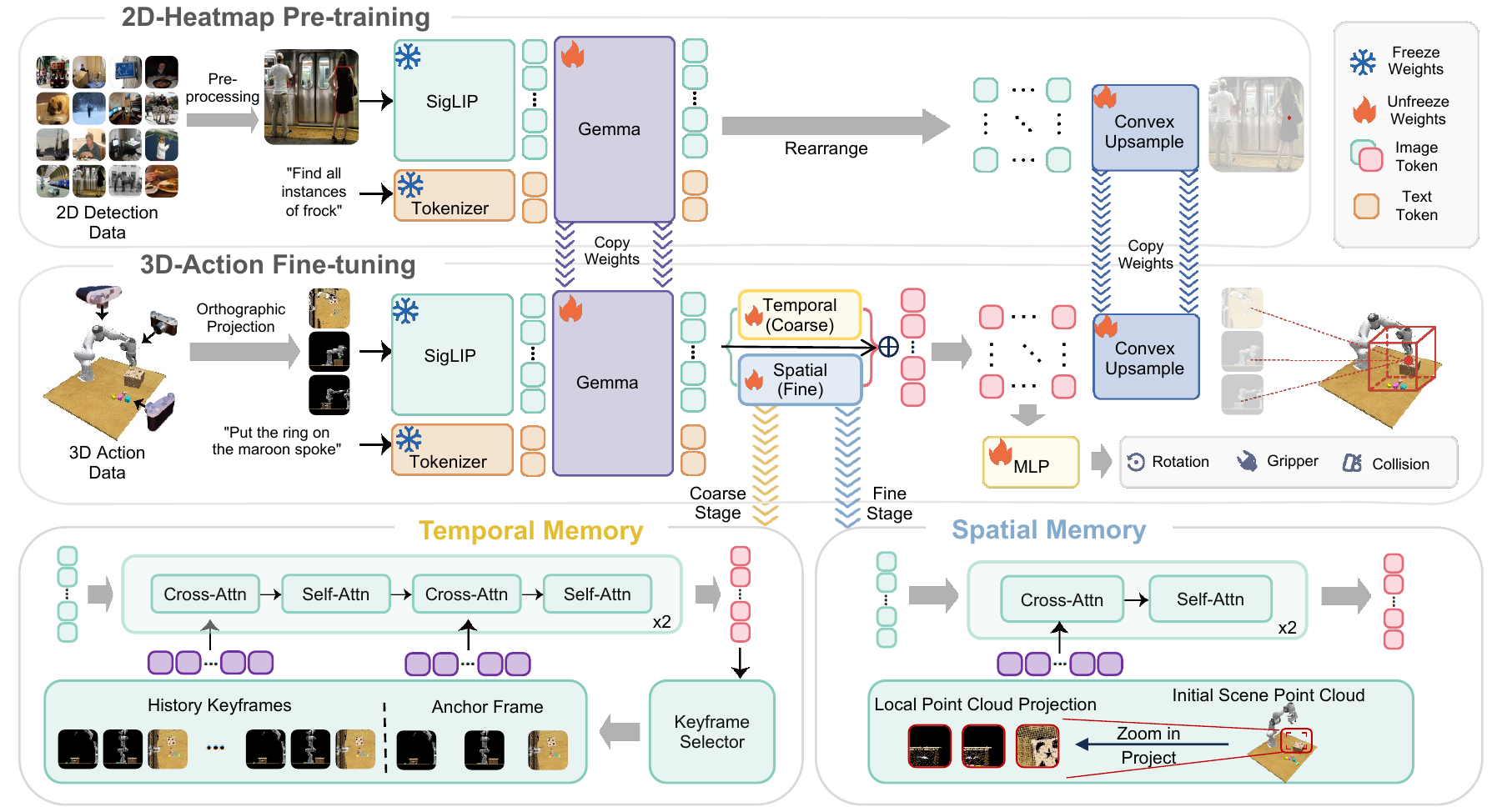
A pre-trained VLM is fluent in images and language, not in point clouds and 6-DoF poses. BridgeVLA closes the gap from both ends — the input is rendered back into images, the output is expressed as heatmaps in that same image space.
Render 3D back into 2D
Point clouds become three orthographic views, so the VLM keeps seeing the kind of images it was pre-trained on.
Pre-train on heatmaps
Before any robot data, the VLM learns to ground language as 2D spatial heatmaps.
Coarse-to-fine action
Per-view heatmaps vote on the next waypoint; a zoomed second pass sharpens it.
Part II · Memory
BridgeVLA++ — unified spatio-temporal memory
The coarse-to-fine design exposes exactly two places where the past helps: the coarse stage must know what has already happened; the fine stage must see geometry the arm is now hiding. Each gets its own memory — both in patch-token space, so the heatmap action interface never changes.
Temporal memory → what to do next
At the coarse stage: the interaction history, with a lightweight gate that keeps only the keyframes worth remembering.
Spatial memory → where exactly to act
At the fine stage: the initial, less-occluded point cloud, re-rendered under the current zoom as complementary geometry.
Additive & bimanual
Memory is injected without touching the action heads; one shared scene memory extends the framework to two arms.
Base-model design ablations (RLBench)
| Variant | Avg. SR (%) ↑ | Avg. Rank ↓ | Insert Peg | Place Cups | Put in Cupboard | Screw Bulb | Sort Shape | Stack Blocks | Stack Cups |
|---|---|---|---|---|---|---|---|---|---|
| BridgeVLA (full base) | 90.5 | 4.75 | 91.2 | 58.4 | 91.2 | 93.6 | 55.2 | 84.8 | 88.8 |
| ├ w/ discretized rotation | 88.2 | 4.86 | 88.0 | 58.4 | 73.6 | 87.2 | 60.8 | 76.8 | 81.6 |
| ├ w/o heatmap decoding | 31.4 | 12.78 | 0.0 | 1.3 | 5.3 | 2.7 | 4.0 | 0.0 | 0.0 |
| └ w/ 3D position input | 56.2 | 10.14 | 26.7 | 14.7 | 10.7 | 16.0 | 21.3 | 17.3 | 4.0 |
Table 9. Base-model ablations. A representative subset of the 18 RLBench columns; the averages and ranks are over all 18 tasks. w/o heatmap decoding and w/ 3D position input use three seeds, the others five.
Predict heatmaps, not coordinates −59.1
Regressing target coordinates instead of decoding heatmaps collapses RLBench from 90.5% to 31.4%.
Don't feed 3D positions to the VLM −34.3
Fusing explicit per-pixel 3D positions shifts the image features off the pre-training distribution.
Pre-training carries language generalization
Without 2D-heatmap pre-training, the policy fails to generalize to unseen language in the real world.
Continuous 6D rotation beats discretization −2.3
The 6D head also avoids the gimbal lock of discretized Euler angles in near-vertical poses.
Memory ablations
Each memory is load-bearing on exactly the benchmark whose difficulty it targets.
| Variant | RLBench Avg. ↑ | Insert Peg | Place Cups | Sort Shape | Stack Cups | Place Wine |
|---|---|---|---|---|---|---|
| BridgeVLA++ (full) | 93.7 | 99.2 | 76.8 | 72.0 | 98.4 | 95.2 |
| ├ w/o spatial memory 𝒮 | 92.0 | 95.2 | 74.4 | 60.8 | 92.8 | 78.4 |
| └ w/o temporal memory 𝒯 | 91.9 | 82.4 | 57.6 | 73.6 | 93.6 | 90.4 |
Table 10. Memory ablations on RLBench. Removing 𝒮 costs most exactly in the occlusion-heavy precision tasks it targets (sort shape 72.0 → 60.8), and removing 𝒯 costs most where a stable global reference helps (place cups 76.8 → 57.6) — even though RLBench tasks are not intrinsically memory-dependent.
| Variant | Overall Avg. ↑ | M(1) Avg. | M(n) Avg. | Rearrange Blocks | Cover Blocks | Press Button |
|---|---|---|---|---|---|---|
| BridgeVLA++ (full) | 96.0 | 95.2 | 97.0 | 100 | 99 | 93 |
| w/o 𝒮 (spatial memory) | 95.4 | 96.2 | 94.5 | 100 | 91 | 92 |
| w/o 𝒯 (temporal memory) | 21.3 | 27.0 | 14.3 | 11 | 5 | 0 |
| BridgeVLA (no memory) | 18.9 | 19.0 | 18.8 | 0 | 3 | 0 |
Table 11. Memory ablations on RMBench. The 2×2 memory factorial. Removing 𝒯 collapses the benchmark from 96.0% to 21.3%, essentially back to the memory-free base (18.9%); removing 𝒮 is nearly harmless here, because RMBench stresses temporal sequencing rather than geometric alignment.
@misc{li2026bridgevlaplus,
  title         = {BridgeVLA++: A Data-Efficient, Generalizable, and Memory-Augmented
                   Vision-Language-Action Framework for 3D Manipulation},
  author        = {Peiyan Li and Yuze Zhu and Yixiang Chen and Qisen Ma and Yuan Xu
                   and Jiabing Yang and He Guan and Yan Huang and Hongtao Wu and Xiao Ma
                   and Tao Kong and Liang Wang and Tieniu Tan},
  year          = {2026},
  eprint        = {2608.05042},
  archivePrefix = {arXiv},
  primaryClass  = {cs.RO},
  url           = {https://arxiv.org/abs/2608.05042}
}If you build on the conference version:
@misc{li2025bridgevla,
  title         = {BridgeVLA: Input-Output Alignment for Efficient 3D Manipulation
                   Learning with Vision-Language Models},
  author        = {Peiyan Li and Yixiang Chen and Hongtao Wu and Xiao Ma and Xiangnan Wu
                   and Yan Huang and Liang Wang and Tao Kong and Tieniu Tan},
  year          = {2025},
  eprint        = {2506.07961},
  archivePrefix = {arXiv},
  primaryClass  = {cs.RO},
  url           = {https://arxiv.org/abs/2506.07961}
}